

I’ve always been fascinated by the undersea world. As a fisherman, I’m amazed by the technology available today that allows anglers to peer into the depths beneath the waves. Equally impressive is that the technology available to recreational boaters and fishermen is surprisingly affordable. This has led to an almost universal adoption by the angling community. But do anglers truly know how to use and interpret these devices correctly? This is what I intend to explore in this article.
Recent Charter in Miami
On a recent trip to Miami, I had the opportunity to go on a deep sea fishing charter with local legend, Captain Ralph Mayans. He made fishing seem easy with the help of his sonar. And once the fish were located, the GPS took over to keep us on the fish. I spent the day picking his brain on how to properly use the boat’s electronics.
First, A Brief History
Sonar technology is not new. It’s been available to the recreational boating public in its initial form as rudimentary echo sounders since 1959, when Lowrance introduced the “Little Green Box”. Essentially, a screen the size of a baseball, where dots would flash on the screen to indicate your depth. Ten years later, Lowrance launched the graph recorder, which used a stylus to burn an image of sonar output onto a roll of heat-sensitive paper, creating a continuous picture of what lies beneath the boat. The next significant milestone was the evolution of these sonar images displayed on electronic screens, with the first use of color LCD displays in the 1990s.
How Many Boats Actually Run Sonar?
Exact numbers are elusive, but the global fish-finder market is currently valued at nearly $1 billion dollars. In the U.S., BoatUS estimates that 85% of registered powerboats are equipped with sonar. Heck, it’s now commonplace to see portable sonars mounted on fishing kayaks.
How Sonar Works and How to Read It
A fish finder sends out a soundwave and then interprets the echo produced by the sound bouncing off objects. The soundwaves are transmitted using a transducer, usually attached to the transom or molded into the keel on fiberglass boats. The sound pulses can be transmitted using various frequencies (50–200 kHz), depending on specific use cases.
Those pulses bounce off the bottom, fish, bait, and so on, then return to the sonar, where the results are interpreted and displayed on the screen. In a nutshell, the time between pulse and return equals depth, and the strength of the returning signal equals the density or hardness of the targets displayed.
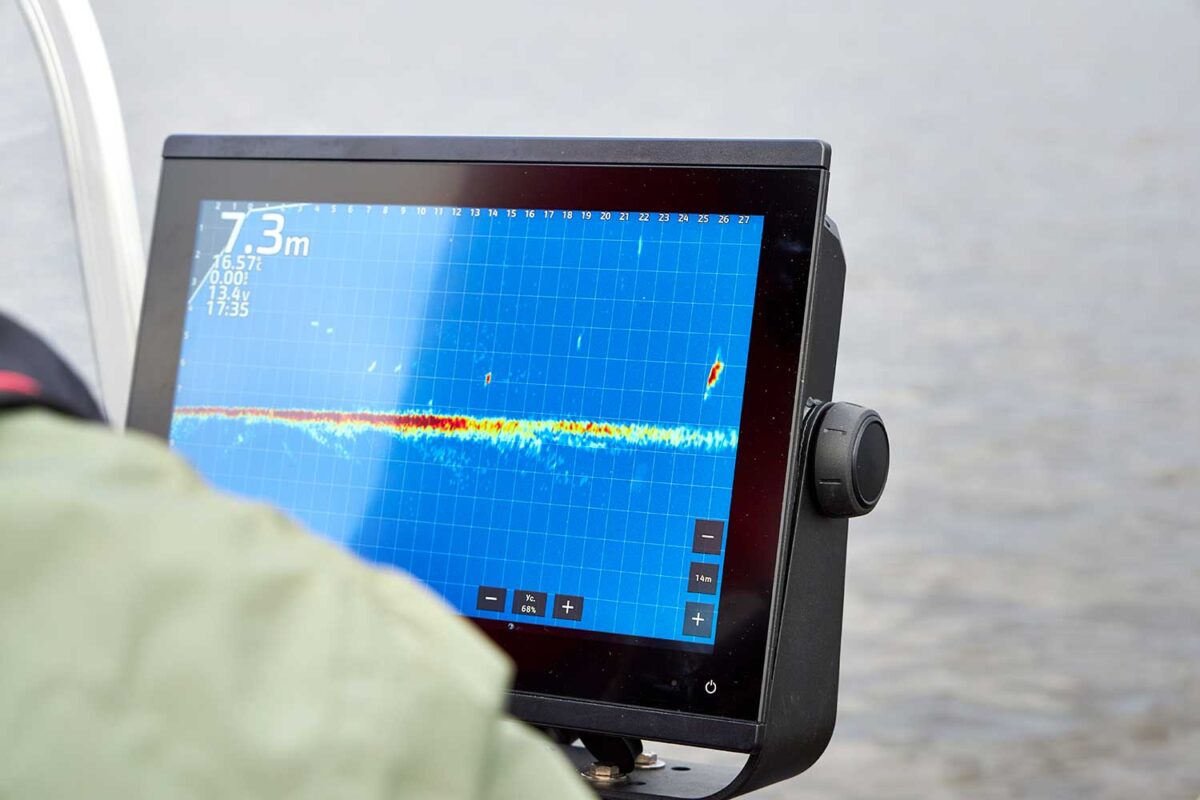
Here’s what to look for:
- The Bottom Line: A thin, solid red or orange band is hard sand or coral. A thick, fuzzy blue line means mud or grass.
- Fish Arches: Classic giveaway. A fish swimming through the cone starts as a dot on the right, rises into a rainbow arch, and then fades to the left. Half-arch? The fish just grazed the edge of the cone. Full arch = directly under you.
- Bait Clouds: Wispy blue-green smudges, often football-shaped. Predators lurk nearby.
- Thermoclines: Horizontal gray bands where warm and cold water meet—big-fish highways.
- Color Palette: Red/orange = strong return (rocks, big fish). Yellow = medium. Blue = weak (bait, soft bottom).
Pro tip from Captain Ralph: “Crank sensitivity to 80–90% when running, then dial it back to 70% when you stop. Too much gain and you’ll paint bait that isn’t there.”
Reading the Screen Like a Pro
- Zoom in on the Bottom: Lock the zoom window on the lower third of the water column—90% of fish live there.
- Frequency selection: 200 kHz for shallow detail; 50 kHz when probing 300-400 foot wrecks – specialized transducers can probe even deeper. CHIRP technology sweeps a band of frequencies for sharper contact separation.
- Mark & Return: For units networked with GPS, hit “Waypoint” on any promising target and navigation guides you back to within 10 feet.
Some fishing pros say it’s like “video-game fishing.” Critics say it’s too easy. But Ralph points out, “You still gotta entice a strike, set the hook, and bring ’em in.”
The Takeaway
Whether you’re a weekend warrior on a 17-foot skiff or run charters out of Haulover Marina, sonar has leveled the playing field somewhat among anglers. If you’re in the market for a new unit, there are many budget-friendly options starting around $200, with top-of-the-line units well into the thousands.